Who isn’t captivated by the idea of a hidden place of wisdom and knowledge somewhere in the world? All cultures and civilisations have some kind of legend or story regarding a utopia; but none have captured the imagination of humanity to the extent that the myth of Shamballa has for centuries.
This Book follows one of the most familiar and elusive of all spiritual concepts known worldwide as Shamballa or even “Shangri-La”. Part Eastern myth, part esoteric philosophy, it speaks to a deep and timeless desire for enlightenment and peace that never seems out of reach.
It speaks of the presence and the guidance of an all-Present and all-Active Spiritual Master. In this Book this land of enlightenment is followed back through the ages to its roots in the heart of Asia to reveal a place and a concept that represent the highest ideals of human endeavour and the perennial hope of humanity for peace and enlightenment.
In traditional literature Shamballa is located on earth in a remote part of Central Asia in the mountains, hidden from human sight. However it is said to be located beyond the Himalayas or in the Gobi Desert, and only accessible to those who are sufficiently pure of heart and spirit to be called there, to a place on earth referred to as ‘the secret place’. Shamballa is described as a place where wisdom and spirituality dominate and where those of the highest evolution reside.
The Myth of Shamballa in Eastern Traditions
Shamballa originates from Eastern spirituality and is derived from the Sanskrit word “Shambhala”, meaning place of peace or simply, place of silence. Although myths surround the place’s existence, Shamballa is mentioned in various sacred texts. In Tibetan Buddhist tradition, Shamballa is described in the Kalachakra Tantra as a “hidden” land where only the most worthy beings can reside.
This mystical place is inhabited by people who are filled with unconditional love and wisdom, and are not subject to physical or material sufferings. The concept of Shamballa is often depicted as an ideal society of the most enlightened beings. The community lives in a state of ultimate enlightenment, thus, Shamballa is seen as the most enlightened community.
The Eastern scriptures are replete with allusions to the mysterious lost kingdom of Shamballa and its connection with the evolution of humanity. In the Hindu scriptures the future avatar of Vishnu is Kalki, who is to appear on Earth and bring about the advent of a Golden Age. It is said that this Avatar will appear in Shamballa, the mysterious island which is already now the centre of the Higher Life on Earth. In some Buddhist schools Maitreya is regarded as the Ruler of Shamballa, the future Buddha who is already at the head of the kingdom, waiting for the time of His appearance in the world of our physical senses.
There are also many legends which speak of a long line of wise kings who have guarded the sacred traditions of the mysteries for the use of humanity, and it is said that the final king of Shamballa, Rudra Chakrin, will descend with His great army at the end of an age of ignorance and materiality to fight against the forces of evil and to establish for all time the reign of peace and the expression of the Christ principle on Earth. This prophecy, given in the teaching of the Kalachakra, the Wheel of Time, of which the lamas of the Tibetan school are the custodians, symbolizes the ultimate victory of the light of the Christ principle over the forces of material evil; though, as I have already indicated, many of the lamas interpret this prophecy in a purely symbolic fight between the two opposing forces of evolution.
Eastern teachers speak of Shamballa in terms far removed from any idea of a physical place that can be pinpointed on a map. The word is used by the Eastern masters to indicate that the Realm of Shamballa has outer, inner and secret meanings. To the unprepared mind the outer Shamballa is seen and believed in as a lost valley or hidden kingdom on earth. The inner Shamballa is a state of consciousness; the secret meaning has reference to the mystical experience of the initiate in the realm of meditation.
The Dalai Lama himself, when He gave the Kalachakra initiation in 1985, spoke of the Shamballa as “it is not a physical place that we can actually find; this place can be achieved only unless one has the merit and karmic connection.” In the light of these teachings, it becomes apparent that the Shamballa referred to by the Eastern teachers is a “pure land” and is obtainable only by those who are sufficiently advanced in evolution to be able to perceive it, in a realm higher than our earth plane.
In the Eastern world there is a place called Shamballa, a place of hope and of spiritual completion, ultimate truth. Whether it is a geographical place on earth, a hidden country, or a higher dimension of existence, there the Masters of the past ages reside, preserving the heritage of ancient wisdom until the time for its distribution to a ready world shall have come.
Shamballa is the land of peace, the land of compassion, the land of courage and wherever these qualities are manifest, whether in the life of a monk or yogi, or in that of a layman, the desire to make them manifest in earth life through the process of meditation is stirred.
Western Esoteric Interpretations and Fascination
Shamballa is not only a part of Asiatic mysticism but is even today the focal point of the interest of many Westerners who are engaged in the work of humanity’s evolution. The legend of the “Lost Land of Shamballa” has captured the imagination of the world and particularly of the Western world since the late 19th century and early 20th century. Many of the Buddhist and Hindu scriptures were translated into the Western languages in this period. The theosophists and occult philosophers of the Theosophical Society wrote about Shamballa and it has featured in the works of many Western esoteric writers.
They describe Shamballa as the real home of the “ascended masters”, the ascended beings or great sages and enlightened beings who are constantly at work helping humanity on its long journey home. These Masters are surrounded by a hidden mystic brotherhood who are constantly working for the evolution of humanity. Shamballa is a place of higher dimension and while it may not be visible to men of ordinary sight it is as real as anything that we can see and touch on the higher planes of existence.
The mysterious land of Shamballa, described by theosophist Alice A. Bailey as an ‘extra-dimensional place of existence on the astral plane’, is ‘the city of light’ where resides the governing deity of Earth – a great being known as Sanat Kumara or the ‘Lord of the World’. Shamballa is the crown chakra of the Earth and the seat of the divine Will. Here plans for human evolution are determined. Shamballa transcends the concept of the hidden kingdom or even a mysterious land, representing the spiritual heart of the Earth.
The Theosophists place Shamballa in the earth’s interior, in a region of high mountain ranges, lakes, and rivers, surrounded by snow-covered mountains mirroring those on the earth’s surface. They also identify Shamballa as the location of the homes of many of the enlightened Masters of Wisdom, known as the Great White Brotherhood. These beings are described as being very advanced, and are said to include some who were once human and have achieved the highest level of initiation. They are described as working quietly behind the scenes to assist the evolution of humanity.
According to Theosophy, at least some of the Masters of Wisdom of the Great White Brotherhood made contact with Theosophical founders Helena Blavatsky and Henry Steel Olcott, and continue to be active today. The writings of Theosophy describe Shamballa as a place of sacred retreat, and as the physical location of the Hierarchy of Masters who work under the direction of the Divine Will of Shambhala. Many of the enlightened Masters of Wisdom described by Theosophy are said to be the same beings who in Eastern tradition became the Dipankara Buddha, or a king of Shambhala, and are thus the same beings described in other cultures and traditions under different names.
Many believed that the mythical spiritual land-mass could be found and the Western imagination was captivated by the notion of a hidden paradise. The search for Shamballa became a subject of much speculation and several explorers and travelers were said to be on the look-out for it. In the 1920s, a Russian artist-philosopher Nicholas and his wife, Helena Roerich embarked on a great journey of discovery into the Himalayas, deep into ancient Mongolia and across the Gobi Desert in search of the fabled land-mass. The couple’s travel diaries are still widely read today and their experiences are both fascinating and inspiring. They were Theosophists and believed in reincarnation and the inner planes of existence.
A fellow Theosophist and friend, Helena Blavatsky had written The Secret Doctrine, in which she described a lost continent of Shambhala, also known as Shang Shambhala. She wrote of this place in the late 19th century. Helena Roerich translated this book into Russian in 1913. After years of trekking across the steppes and mountain ranges of Asia in search of the place, Nicholas Roerich finally found it. He even painted a series of paintings of his experiences in this fabled place and he titled them: “Song of Shambhala”. He was not alone in his search. Some say that spies and agents of world powers have been and are still searching for this mythical land-mass. Tibet was invaded by both Nazi and Soviet forces in the 1930s in a frenzied search for the fabled lost kingdom of Shamballa (also sometimes referred to as Agartha). The head of Stalin’s secret police, Gen. Yagoda, was said to have used the occult knowledge said to be hoarded in Shamballa to wrestle for power in the Soviet Union.
Somebody has to ask: did anybody ever really find this fabled place called Shamballa? The answer is that certainly no explorer ever found a place he called Shamballa, but that is because the legend has long since grown into a powerful symbol of the Higher Life on Earth, representing wisdom and peace. Actually the word was first used by a clergyman named Ivan Ksfandel in a novel of the same name in 1886; however, it was James Hilton who forever enshrined the name in popular literature in his best selling novel Lost Horizon in 1933, in which a group of stranded travelers stumble upon a hidden lamasery high in the Himalayas, a paradise of eternal life, beauty and bliss which he named Shangri-La. The word instantly became part of the lexicon of the world and is used daily in magazines, newspapers, books, lectures and conversations, influencing people’s conceptions of what the actualized enlightened world is going to be like.
Who Are the Spiritual Masters of Shamballa?
There are the Spiritual Masters of Shamballa – the Beings of the highest spiritual evolution who inhabit that mysterious Realm. Who are they ? The legends and teachings speak of them differently – but one fact stands out: the inhabitants of Shamballa are not ordinary human beings, but highly evolved Consciousnesses who guard the Sacred Teachings and guide the evolution of mankind.
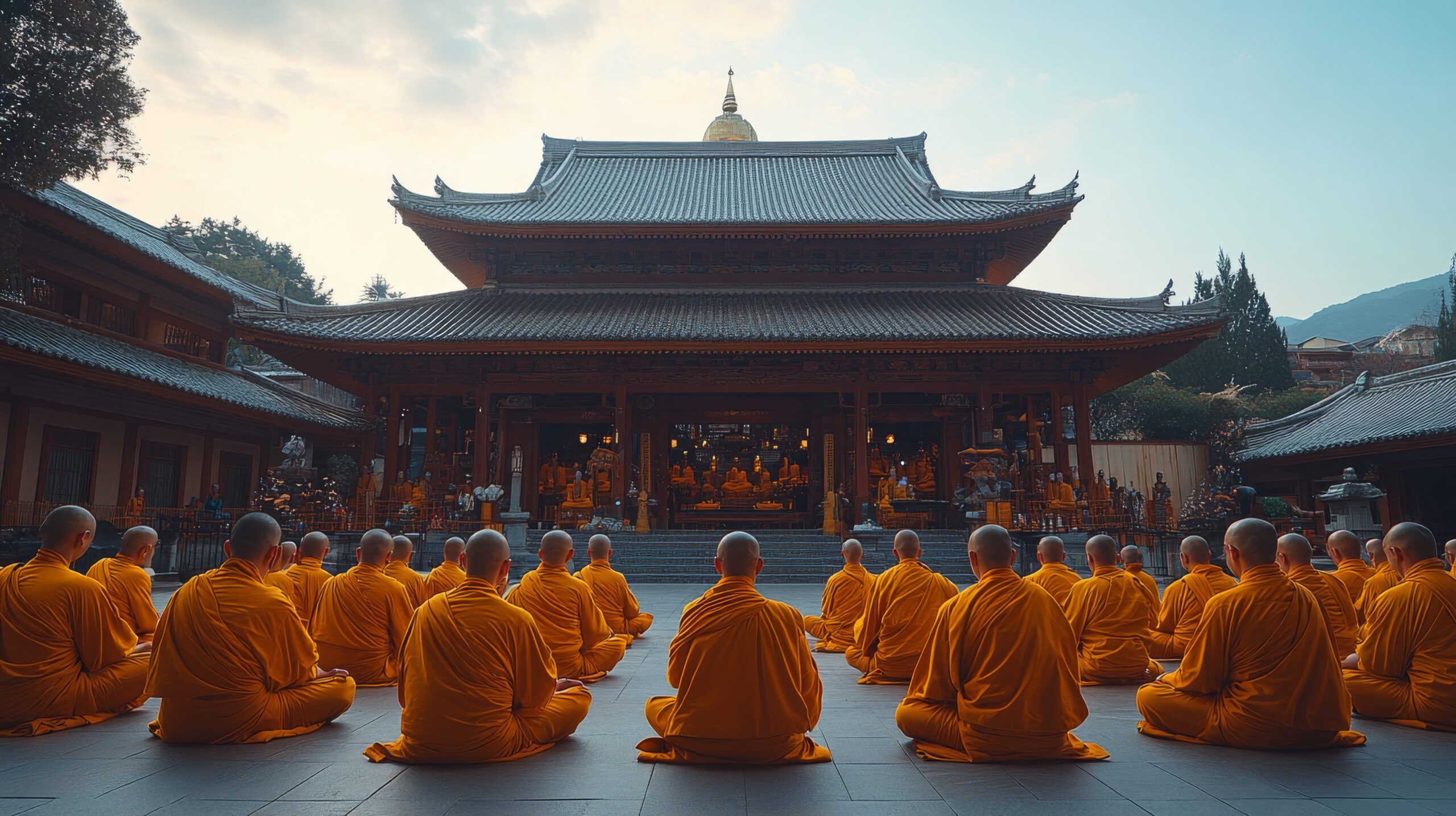
The members of the ‘Masters of Shamballa’ would be the Kings of Shambhala and their retinue of monks and lay people. In the Kalachakra Tantra there are said to be 32 Dharma Kings ruling in Shambhala, each propagating the teachings of the Buddha. The first King Suchandra received the special teachings of the Kalachakra (Wheel of Time) from the Buddha himself and since then these teachings have been passed down from generation to generation of the Dharma Kings of Shambhalla. The present King of Shamballa waits for the hour to mobilize the forces of light against darkness. In addition to the Kings there is a vast and enlightened community of lamas, bodhisattvas and enlightened beings. Future Buddha Maitreya is said to be still teaching in the courts of Shambhala. In this legend the masters of Shamballa are still around, they are bodhisattvas or already fully enlightened monks, holding the light of Dharma until the time is ripe to come to our world and dispel ignorance.
The Theosophical and New Age tradition presents the masters of Shamballa in a metaphysical light. The Masters of Shamballa are the enlightened beings who have achieved the status of Ascended Masters; the state of complete human evolution in which all physical and emotional limitations have been transcended. Some consider Jesus and Buddha to be two of the Ascended Masters, or at least expressions of the same divine essence, while others acknowledge the presence of less well known adepts who have worked on the earth-physical plane and have achieved the status of masters. They are said to be working on the higher planes to help humanity evolve into its next stage of development. Shamballa is said to be the place where the masters gather; the headquarters of the Shamballa forces on the earth’s etheric plane.
There is a “hidden brotherhood” of wise beings living on earth as described in various Theosophical writings and in many mystical traditions. While we don’t know for certain the identities or all the incarnations of all such members, we are given the names of a few (e.g., Master Morya, Master Koot Hoomi, etc.). However, in some teachings this mystical “hidden brotherhood” feels more connected to Shamballa than the third dimensional world of duality that we experience. That doesn’t mean to say that they all physically reside there in incarnation but this would be their spiritual home or place of work. In many stories, including legends of the ages and various mystical traditions, Shamballa is said to be a city of light (the Fifth Dimension of the afterlife world), that only the most highly evolved beings are able to attune to and therefore perceive.
Sanat Kumara – the Lord of Shamballa. There are many said to be the Lord of Shamballa – each in their own time and space. In Eastern legend this being came to Earth eons ago in order to assist the evolution of the planet and its people spiritually. Said to reside on the inner plane in Shamballa, the place of the spiritual government of the Earth, He is assisted in the governing of this realm by the regent of Shamballa. In Buddhism there is said to be a final world-saving king.
In Theosophy this being is spoken of as Raudra Chakri (Rudra Chakrin) – the last king of Shambhala. He is the Lord of Shamballa, head of the brotherhood of the masters who are the wisdom keepers of the Earth. These beIngs are overseen by Sanat Kumara who directs them in their work of overseeing the evolution of the various cultures, religions and the many sciences that have been brought to the Earth. They direct major events on the planet in order to further the evolution of humanity.
What is the purpose of these spiritual masters?
There are many legends and secret teachings that speak of this mission of guarding and of helping to release the divine wisdom of the ages. Many speak to those who hold the keys of wisdom not to keep them a mere treasure but to use them and to bring them forth in the right place and the right time. The laws of Dharma are said to be stored in Shamballa and the knowledge of ancient Root-Races. The Masters of Shamballa work when humanity is plunged in moral darkness and when humanity is ready to evolve to a higher plane of living. Then they take action by sending a Teacher, by inspiring a new philosophical movement, or by incarnating themselves.
This divine Presence and Source also appears on Earth in human form as The King of Shamballa at the end of the age, coming to save the world. However in Theosophy the Masters do not claim all of the credit; their influence may prompt or inspire individuals or groups who then develop into great reformers, great scientists and so on. The person or group may or may not realise the divine inspiration. Whatever, it is the Masters working and the Masters’ influence to help humanity’s evolution on all levels. This great and powerful source of inspiration and guidance is seen by many spiritual people as the cause of great movements of human progress such as the renaissance, the humanitarian movement, nonviolent resistance and other historic advances of the human spirit.
The legends of enlightened masters living in a hidden or mystical place in Tibet or the Himalayas, Shamballa or Shang Shung, can be seen from several points of view. Some will speak of actual physical enlightened beings, physical or in hidden locations on earth. Others will speak of ‘archetypes’ of the various levels of spiritual evolution that all humans must undergo. Some believe that such a place and the masters dwelling there actually exist on earth and are called Shamballa, though its location is unknown.
Others believe that the land of Shamballa and its masters exist in a higher dimension or on other planes of existence, that they are ‘immortal’ and could reveal themselves to humanity at will. Still others speak of such masters and a geography of inner realms as symbols of various higher states of human consciousness or as expressions of the higher wisdom of all of humanity. Now, I’m not 100% convinced on either point, but that’s what makes this an intriguing subject.
Shamballa’s Relevance in Modern Times
The legend of Shamballa. Why should we be interested in this legend? The legend of Shamballa inspires us to the highest hopes for humanity. At a time when humanity is plunged in materialism and conflict, the thought of a place of peace, of supreme Enlightenment, of Seers who watch over us and of Masters who are ever near, can give great hope and inspiration. Whether or not there is a physical Shamballa, there are realms of the inner world where peace and wisdom are ever-present and can manifest at will.
In many contemporary spiritual writings Shamballa is mentioned and referred to in various ways. Tibetan Buddhist schools and sects study the teachings and the practices of the Kalachakra King and visualize the existence of a geography called Shambhala (or Shamballa) where these great enlightened Beings reside. The famous Kalachakra Initiation is given by the Dalai Lama and other Tibetan Masters and speaks of the prophecy of Shamballa and the need to develop the pure heart quality required to ‘attain to’ or reach Shamballa whether physical or not.
The Shamballa masters (the ascended masters) are frequently written about in New Age writings and are used in many different teachings and healing modalities. There is one energy healing system known as Shamballa Reiki that uses the energy of the masters from Shamballa, a place of great compassion.
To some, Shamballa is the name of the jewelry company. To others, Shamballa is a place or state of being that existed long ago and was lost in time. I was drawn to the concept of a “hidden land of wisdom” in an often very painful world filled with suffering and darkness. As I have delved into the company and its teachings, I see that we can invite the energy of Shamballa into our lives when we make the commitment to heart-centered peacefulness and seek the truth of our highest potential. We can share our love and compassion with all souls and be a force of light in the world.
One can also view the Spiritual Masters of Shamballa in another light. They can be considered aspects of our own higher self or protectors of our better half. In this light the legend is most spiritually relevant for it encourages us to become our own masters and to find the kingdom of heaven, the mandala of Shamballa within ourselves. Thus the legend is not something that is to be hoped for in some future incarnation in the form of hidden masters who are going to save the world for us.
Mandala of Enlightenment: In Tibetan Buddhism, Shamballa is often depicted as a sacred mandala (spiritual diagram) like the one above. Such mandalas symbolize a perfected world of enlightenment. They remind practitioners that Shamballa is both a place and a state of mind – a vision of what our world could be at its highest potential.
In our busy lives, Shamballa’s tale urges us to pause and reflect on life’s deeper meaning. It merges mysticism and philosophy, inviting us to believe in something beyond the ordinary. Whether or not Shamballa’s masters are real, their message endures: wisdom and goodness will prevail, and an unseen order exists amid chaos, upheld by enlightened principles. We can connect to this higher order through introspection, ethical living, and openness to the unknown.
In conclusion, Shamballa’s masters remain a matter of faith and personal belief. Historically, the myth bridges East and West – from ancient prophecies to modern mystics. Culturally, it persists in books, films, and spiritual discussions. And spiritually, it symbolizes ultimate enlightenment.
Whether a hidden kingdom or a metaphor for a higher plane, Shamballa’s masters remind us to embrace peace, compassion, and wisdom. In this way, Shamballa is “real” – not on any map, but in the hearts of seekers. As the saying goes, “When the student is ready, the master appears.” Perhaps we are all journeying toward them, whether in distant mountains or within our souls.
References
Dalai Lama’s commentary on Shamballa (Kalachakra Initiation, 1985) – Quoted in various sources about Shamballa not being a physical place.
https://www.dalailama.com
Theosophical Society & Alice A. Bailey writings on Shamballa – Esoteric views on Sanat Kumara, ascended masters, and Shamballa as a spiritual centre.
https://www.theosophy.world
Nicholas & Helena Roerich’s Shamballa Expeditions – Accounts of the 1920s Himalayan expedition in search of Shamballa.
https://roerich.org/roerich-expedition
“Shambhala” – Myth and Meaning (Ancient Origins) – Overview of Shambhala in Hindu and Buddhist texts, including Maitreya and Kalki prophecies.
https://www.ancient-origins.net/myths-legends/shambhala-myth-and-meaning-002739
Tibetan Buddhist View of Shambhala (Kalachakra Tantra) – Prophecies of Shambhala’s kings and the future battle against ignorance.
https://www.sacred-texts.com/bud/tib/shambhala.htm
National Geographic – Nazi and Soviet Expeditions into Tibet – Historical note on political interest in Shamballa.
https://www.nationalgeographic.com/history/article/nazi-expedition-tibet
Lost Horizon by James Hilton (1933) – Fictional inspiration for Shangri-La, influenced by Shamballa legends.
https://www.britannica.com/topic/Lost-Horizon-novel-by-Hilton
Wikipedia – Shambhala – General overview, including Buddhist, Hindu, and Theosophical perspectives.
https://en.wikipedia.org/wiki/Shambhala