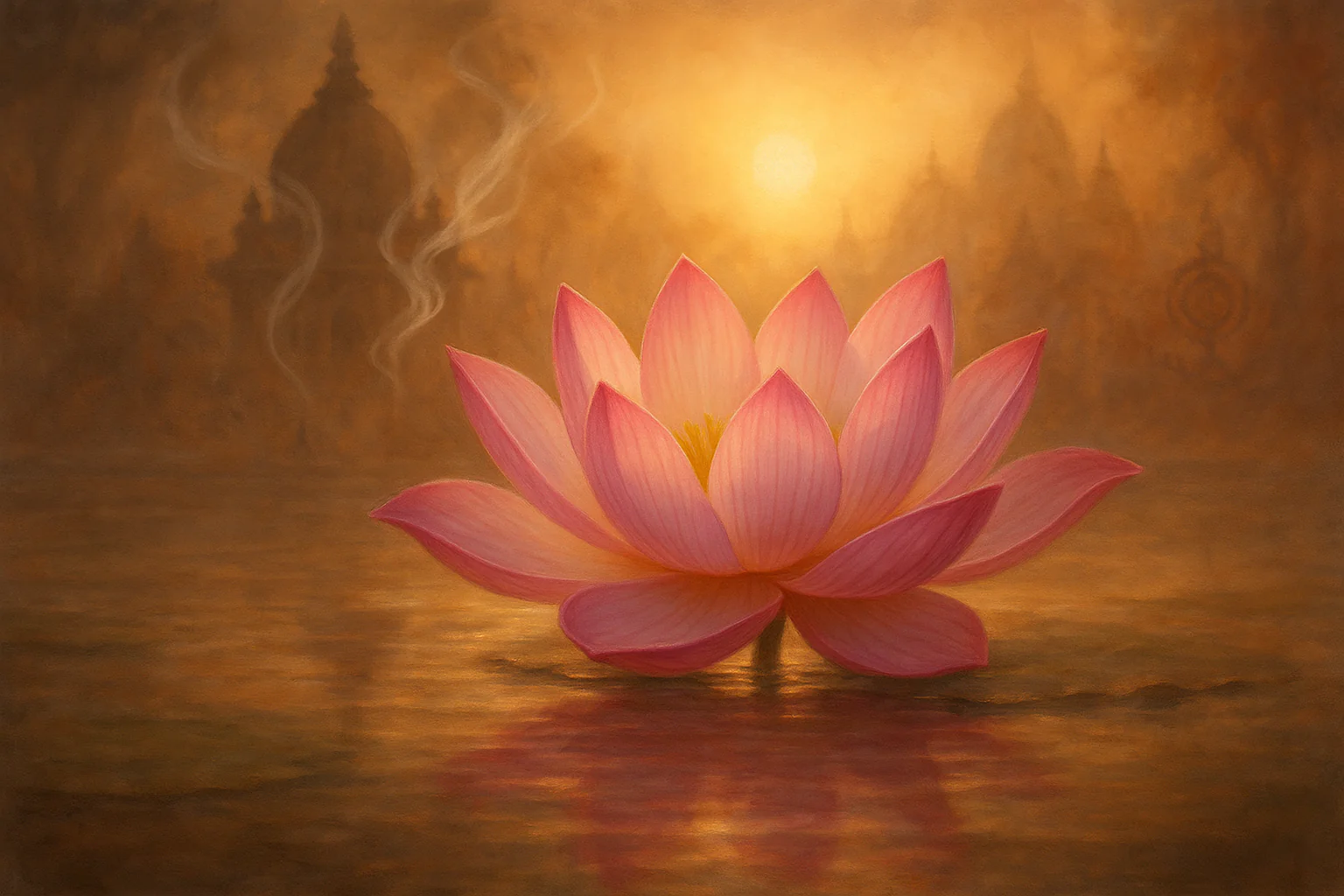
There is a quiet paradox at the heart of the spiritual journey: the very structure that keeps us bound is also the doorway through which awakening unfolds. Ancient wisdom did not seek to destroy the ego, nor did it worship it. Instead, it observed it – patiently, compassionately – much like watching a lotus rise from muddy waters. This is where the idea of the Egoic Lotus begins to breathe.
The lotus does not reject the mud. It grows because of it. Its roots anchor deep in dark, unseen layers, drawing nourishment from what is dense and heavy. And yet, when it blooms, it opens toward the sun with unblemished grace. In the same way, the ego is not an enemy to be defeated but a terrain to be understood. The Egoic Lotus is the recognition that ego, when seen clearly, becomes the very mechanism through which consciousness flowers.
Most of us inherit a misunderstanding early in life – that the ego is something shameful, something to be silenced or annihilated. Spiritual language often reinforces this, speaking of ego-death as if it were a violent erasure. But lived wisdom suggests something gentler. Ego is not a flaw; it is a function. It is the organizing principle that allows a soul to navigate a human world. Without it, we could not form identity, make choices, or even ask spiritual questions. The problem is not that ego exists. The problem is that it believes it is all that exists.
The Egoic Lotus emerges when this belief softens.
At its core, ego is a collection of stories. Stories about who we are, what we deserve, how others should treat us, and how the world ought to unfold. These narratives once served us – protecting us, helping us belong, allowing us to survive. Over time, however, they harden. They become reflexive. We no longer have an ego; we are the ego. Like roots gripping too tightly, it begins to suffocate the very growth it once supported.
The lotus teaches us another way. It does not cut off its roots to bloom. It allows them to remain in the mud while its petals open freely above the surface. Egoic realisation works the same way. We do not exile the ego; we contextualize it. We allow it to remain functional without letting it dominate our inner sky.
This shift does not happen through force. It happens through awareness.
When awareness turns inward, something subtle begins to occur. We start noticing the moments when the ego tightens – when it seeks validation, control, comparison, or superiority. Instead of judging these impulses, we observe them as movements of energy. The ego becomes an object of perception rather than the seat of perception. This is the first petal opening.
There is often fear here. If I am not my ego, then who am I? The mind resists this question, because the ego thrives on certainty. But beneath that fear lies spaciousness. A deeper intelligence. A witnessing presence that has always been there, quietly watching the stories unfold.
Realisation is not a dramatic lightning strike. It is more like dawn. Gradual. Almost imperceptible at first. You begin to notice pauses between reactions. Silence between thoughts. A softness where there was once urgency. The ego still speaks, but it no longer shouts. It becomes a consultant rather than a ruler.
This is the blooming phase of the Egoic Lotus.
In this state, ego serves rather than commands. Identity becomes fluid. You can participate fully in life – career, relationships, creativity – without being consumed by them. Praise no longer inflates you, and criticism no longer collapses you. You discover an inner steadiness that does not depend on external conditions. This is not detachment born of indifference, but engagement rooted in clarity.
What is often misunderstood is that spiritual maturity does not remove personality; it refines it. The lotus does not lose its shape when it blooms. It becomes more itself. Similarly, when ego is integrated rather than suppressed, individuality becomes more authentic, not less. You speak more truthfully. You love more freely. You listen more deeply. Ego stops trying to be divine and instead allows the divine to move through it.
There is humility in this realisation. Not the performative humility that seeks approval, but the natural humility that arises when one recognizes they are a small wave in a vast ocean – and also made of the same water. The ego relaxes when it understands it does not need to carry the weight of existence.
Still, the mud remains. Triggers do not vanish overnight. Old patterns resurface, especially under stress. The difference now is relationship. Instead of identifying with these patterns, you meet them. You ask what they are protecting. You offer them presence rather than punishment. Each time this happens, another petal opens.
The Egoic Lotus is not a destination. It is a living process. Some days the bloom is wide and luminous. Other days it closes slightly, responding to weather, to inner seasons. This too is wisdom. Even the lotus rests at night.
In practical life, this realisation expresses itself quietly. You might notice less need to explain yourself. Less urgency to be right. More comfort in not knowing. You may find yourself choosing honesty over image, rest over performance, depth over speed. These are not moral achievements; they are natural outcomes of alignment.
Perhaps the most sacred aspect of the Egoic Lotus is compassion – toward yourself and others. When you see your own ego clearly, you recognize it everywhere. Not with disdain, but with understanding. You see that most human conflict arises from unexamined fear masquerading as certainty. This recognition softens the heart. Judgment gives way to curiosity. Separation gives way to kinship.
And so, the lotus continues to rise.
The world does not need fewer egos; it needs awakened ones. Egos that know their place. Egos that can bow to something greater without disappearing. Egos that can function beautifully within form while remaining rooted in the formless.
The Egoic Lotus reminds us that enlightenment is not an escape from humanity, but an intimate embrace of it – mud, roots, and all. When ego is seen, honored, and gently transcended, it becomes the very stem that lifts consciousness into light.
And in that blooming, life itself becomes the teaching.