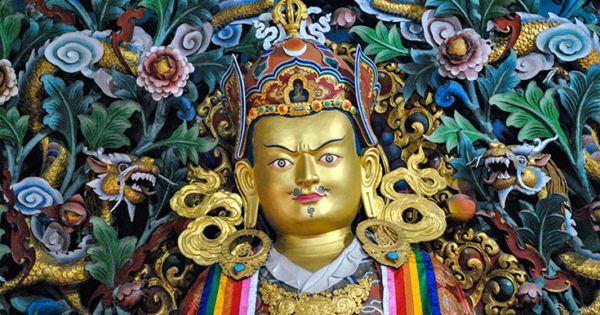
Buddha Padmasambhava, also known as Guru Rinpoche, holds a central place in Tibetan Buddhism. His name means “Lotus-Born.” He is remembered as an Indian Buddhist master who helped bring Tantric Buddhism to Tibet in the 8th century. Britannica describes him as a legendary Indian Buddhist mystic credited with introducing Tantric Buddhism to Tibet and helping establish Tibet’s first Buddhist monastery.
His life story has two sides. One side comes from history. The other comes from Tibetan Buddhist tradition, where stories about him grew over many centuries. Project Himalayan Art clearly notes that the historical record mentions him only briefly, but later Tibetan traditions developed a rich biography around him.
So, to understand Padmasambhava, we should read his life carefully. Not every story can be treated as simple history. But every story tells us how deeply Tibet remembered him.
Key Facts About Padmasambhava
Here are the main points to know first –
- Name – Padmasambhava
- Meaning of name – Lotus-Born
- Also known as – Guru Rinpoche, meaning Precious Guru
- Time period – 8th century
- Origin in tradition – Udyāna, often identified with Swat in present-day Pakistan
- Known for – Bringing Tantric Buddhism to Tibet
- Major connection – Samye Monastery
- Tradition most linked with him – Nyingma, the “Ancient” school of Tibetan Buddhism
Britannica states that tradition places his origin in Udyāna, now associated with Swat in Pakistan, and says he taught at Nalanda, a major Buddhist learning center in India.
The Meaning of “Lotus-Born”
Padmasambhava’s name is important. “Padma” means lotus, and “sambhava” means born or arisen. In later Tibetan biographies, he is said to have appeared on a lotus in northwest India. Project Himalayan Art explains that the first full narrative of his life, compiled by the treasure revealer Nyangrel Nyima Wozer, begins with Padmasambhava being found on the pistil of a lotus.
For a young reader, this may sound like a fairy tale.
But in Buddhist symbolism, the lotus has meaning. It grows from muddy water but opens clean above the surface. That image helps explain why this birth story became so powerful. It shows wisdom rising from ordinary life.
The story may not work like a modern biography. It works more like a teaching image.
His Training and Buddhist Background
Padmasambhava was not remembered only as a holy man with miracles around him. He was also remembered as a trained Buddhist teacher.
Britannica says he was a Tantrist, a member of the Yogācāra school, and a teacher at Nalanda.
That detail matters.
Nalanda was one of the great centers of Buddhist learning in ancient India. Students studied Buddhist philosophy, meditation, debate, and scripture there. So, tradition presents Padmasambhava as someone with both learning and spiritual practice.
Tantric Buddhism can sound complex, but the basic idea is simple enough – it uses
- meditation,
- mantra,
- ritual,
- and symbols to train the mind.
It does not only teach people to avoid difficult emotions. It teaches them to transform those emotions into wisdom.
Why Tibet Invited Him
In the 8th century, Tibet’s king, Tri Songdetsen, wanted Buddhism to become stronger in his kingdom. According to Project Himalayan Art, the Indian scholar-monk Shantarakshita advised the king to invite Padmasambhava because obstacles were stopping the full establishment of Buddhism in Tibet.
Padmasambhava, as a tantric master, was believed to have the skill to ritually subdue local gods and demons.
Britannica gives a similar account.
It says King Thī-srong-detsan invited Padmasambhava to Tibet in 747, and that he arrived at Samye, where he was said to remove demons that were disturbing the construction of the monastery. He also supervised the completion of the monastery in 749.
A modern reader can understand this in two ways –
- A religious reader may believe these spirits and demons were real beings.
- A historical reader may see them as symbols of local resistance, political tension, or cultural difficulty.
Either way, the story shows one thing clearly – Buddhism did not enter Tibet without challenge.
Samye Monastery and His Role
Samye Monastery became very important because it is remembered as Tibet’s first Buddhist monastery. Padmasambhava’s name stays closely connected with it. Britannica says he helped establish the first Buddhist monastery in Tibet and supervised Samye’s completion.
A monastery is not just a religious building. It creates a place where people can study, translate texts, practice rituals, and train future teachers. Samye helped Buddhism move from royal interest into daily religious life.
This is why Padmasambhava matters so much in Tibetan history. He did not simply visit Tibet. Tradition remembers him as someone who helped Buddhism take root there.
Subduing Demons – What It Means
Many stories say Padmasambhava subdued demons, spirits, and local deities. Project Himalayan Art says later histories describe him as the tantric master who ritually subdued local gods and demons so Buddhism could be established in Tibet.
This is one of the most famous parts of his life story. But “subduing” does not always mean destroying. In Tibetan Buddhist stories, Padmasambhava often converts these forces into protectors of the Dharma, or Buddhist teaching.
That idea is practical. When a new tradition enters a place, it does not always erase the old culture. Sometimes it absorbs, reshapes, and gives new meaning to what people already believe.
His Link with the Nyingma Tradition
Padmasambhava became especially important to the Nyingma school of Tibetan Buddhism. Nyingma means “Ancient.” Britannica says the Nyingma school claims to follow Padmasambhava’s teachings most closely, especially in tantric ritual, worship, and yoga.
Project Himalayan Art also says he became the focal point of the Nyingma tradition, which traces its lineages to his teachings. It adds that images of Padmasambhava appear in Tibetan monasteries across traditions because all Tibetan Buddhist traditions connect in some way to his activities.
This helps explain why people still see his statues and paintings in monasteries, homes, and meditation spaces.
His Students and Disciples
Padmasambhava’s story also includes many important students. Treasury of Lives lists several figures connected with him, including Vairocana, Nubchen Sanggye Yeshe, Yeshe Tsogyel, and Tri Songdetsen.
These names matter because they show that Padmasambhava’s work did not end with him. His students helped carry teachings forward. They translated, practiced, preserved, and spread what they received.
Yeshe Tsogyel is especially important in Tibetan tradition. She is remembered as a major female disciple and spiritual figure. Her presence also reminds us that women played a role in preserving Tibetan Buddhist teachings, even if history often gives more space to kings and male scholars.
Hidden Teachings and Terma
One unique part of Padmasambhava’s legacy is the tradition of terma, or hidden treasures. These are teachings said to have been hidden by Padmasambhava and later discovered by special teachers called tertons, or treasure revealers.
Britannica says texts believed to have been buried by Padmasambhava began to be found around 1125. Project Himalayan Art explains that Nyangrel Nyima Wozer, who lived from 1124 to 1192, became the first of the great Buddhist treasure revealers and helped shape the full life story of Padmasambhava.
This tradition gave Tibetan Buddhism a living feeling. It suggested that some teachings appear when the time is right.
How Padmasambhava Is Shown in Art
Padmasambhava has a very recognizable appearance in Tibetan Buddhist art. Himalayan Art Resources describes his main form with –
- A vajra held near the heart
- A skull cup in the left hand
- A katvanga staff resting near the shoulder
- A lotus hat
- Robes of different colors
- A seat above a lotus rising from Dhanakosha lake
Himalayan Art Resources also notes that his lotus hat is topped with a half-vajra and a single vulture feather.
These details are not random decoration. They show his role as a Vajrayana teacher. They also help followers recognize him easily in paintings, statues, and temple art.
Why Padmasambhava Still Matters
Padmasambhava matters because he stands at a major turning point in Tibetan Buddhist history.
He links India and Tibet.
He links scholarship and tantric practice. He links historical memory and sacred story.
We do not have a long, simple, modern-style biography of him. The sources are limited. But we do know that Tibetan tradition placed him at the center of Buddhism’s early growth in Tibet, especially through Samye Monastery, the Nyingma school, and the terma tradition.
His life path teaches one clear lesson – a great teacher does not only bring knowledge. He helps people receive it. Padmasambhava did that for Tibet, and that is why his name still carries such deep respect today.