Some evenings, the sky does something quietly outrageous.
You step outside for a breath of air and the world feels ordinary- traffic in the distance, the familiar weight of your own thoughts. Then you look up. A single star holds your attention, and suddenly your inner life feels like a small room with a window thrown open. The vastness doesn’t shout. It simply is. And in that presence, a question rises without effort: Where am I, really?
In many Indian wisdom traditions, one response to that question is the idea of lokas- “worlds” or “realms.” Some people picture them as cosmic regions stacked like floors in a divine architecture. Others experience them as layers of consciousness: shifting atmospheres of perception we move through, often without noticing. Either way, the teaching offers something tender and practical: a way to understand life as layered, not flat.
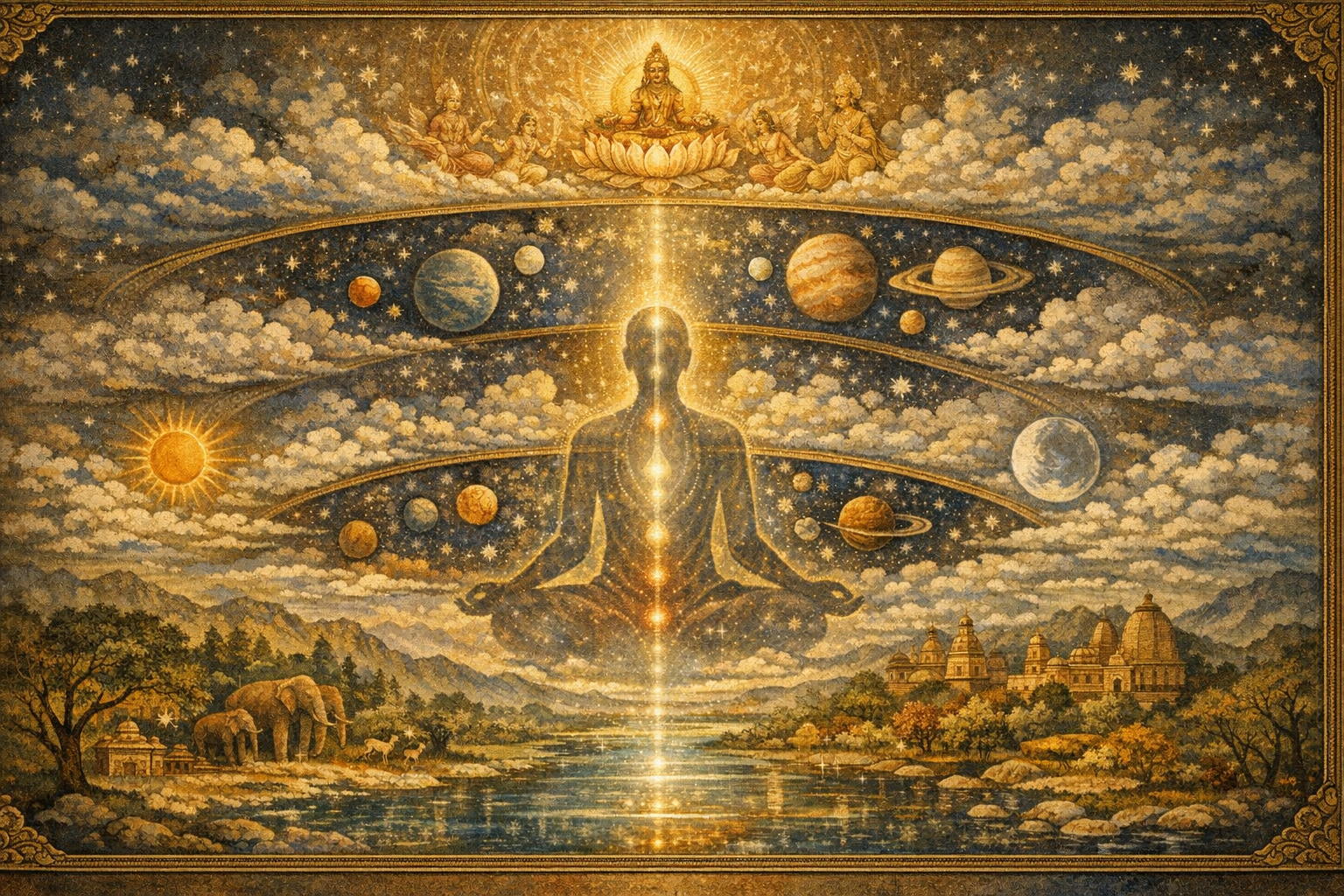
When we speak of Lokas- cosmic, planetary, and human layers, we’re really exploring three mirrors at once:
- the cosmic mirror that reflects archetypal reality,
- the planetary mirror that reflects rhythm and time,
- and the human mirror that reflects our daily choices, moods, and meaning.
None of these need to be taken as rigid geography. You can hold lokas as poetry, psychology, cosmology- or as a blend of all three. The medicine is in the sense of depth they restore.
The word “Loka” as a doorway
The simplest way to approach loka is to hear it as a place you live from.
Not just your physical address, but your inner address.
Think of how quickly a day can change your “world.” In the morning you might live in a loka of possibility; by afternoon, one critical email drops you into a loka of contraction. When you’re grieving, the same street looks different. When you’re in love, the same room feels illuminated. Something in you shifts, and the world reorganizes around that shift.
Lokas remind us that reality is not only what’s “out there.” Reality is also the quality of awareness we bring to what’s out there.
Cosmic Lokas: the architecture of meaning
In classical yogic and Vedic imagination, lokas describe a universe that is not accidental. The cosmos is portrayed as an ordered living field where consciousness expresses itself through layers- subtle to dense, expansive to contracted.
Whether you take this literally or symbolically, cosmic lokas offer a powerful framing: life has levels.
There is the level of survival and instinct, the level of social belonging, the level of creative intelligence, the level of devotion, the level of clear seeing. We recognize these levels in ourselves even if we’ve never heard the word loka.
On certain days, your inner world is heavy and close to the ground. You operate from urgency, irritation, or fear. On other days, something opens: you feel spacious, forgiving, almost lit from within. The events might be the same, but your loka has changed.
Cosmic lokas, held gently, become a map of these shifts.
They also give permission for something many people feel but struggle to name: we are not only one thing.
We are body, yes- but also emotion, memory, imagination, intuition. We are a small creature with deadlines, and we are also a witness that can sit quietly and watch the breath move like a tide. The cosmic view doesn’t deny the ordinary; it places it inside something larger, like a lamp placed within a lantern.
If your life has felt flat- too much news, too many tasks, too little wonder- the idea of cosmic lokas can reawaken a vertical axis inside you. Not “better” or “worse” layers, but different frequencies of being.
Planetary Lokas: the intelligence of rhythm
If cosmic lokas offer architecture, planetary layers offer timing.
Across many cultures, the sky has been read as a living clock: not only for seasons and harvests, but for the subtle moods of collective life. In Indian astrology, planetary influences are often described not as fate, but as patterns of energy- a language of cycles.
Even if astrology isn’t your path, you likely already live by planetary truths:
- The moon moves, and water moves- tides in oceans, tides in our bodies.
- The sun rises and sets, and our physiology responds.
- Seasons turn, and our appetite, sleep, and emotion shift.
Planetary lokas can be felt as the layers of rhythm that shape us: day and night, waxing and waning, effort and rest, outward action and inward digestion.
When we resist rhythm, life becomes abrasive. We push through exhaustion, ignore the messages of our nervous system, treat the body like a machine that should perform on demand. The result is predictable: burnout, numbness, irritability, or a strange sense of being out of step with your own life.
But when we honor rhythm, something softens.
You begin to sense that your “world” changes according to the cycles you respect. A late night of scrolling places you in a different loka than an early morning walk. A week without sunlight is a different loka than a week of dawns. Your inner weather responds to the sky’s weather.
A planetary view of lokas can be a humble reminder: you are not separate from time. You are made of it.
Human Lokas: the worlds we create each day
Now we come to the most intimate layer: the human loka.
This is the world of your home, your work, your relationships, your habits, your inner dialogue- the realm you actively shape.
Human lokas are built from tiny choices.
The words you repeat to yourself become a climate.
The kind of media you consume becomes a soundtrack that colors your nervous system.
The people you spend time with become mirrors that gently guide you toward certain versions of yourself.
If you want to understand your current loka, you can ask three simple questions:
- What do I return to when I’m tired?
- What do I believe is true about me, without questioning it?
- What does my body feel most days- tight, heavy, open, restless, calm?
These are not moral questions. They’re diagnostic questions, asked with compassion.
Because human lokas are not fixed.
You can shift them.
Sometimes the shift is dramatic- a life change, a move, a relationship ending or beginning. But more often, the shift is small and almost invisible: drinking water before coffee, putting your phone away for an hour, walking barefoot on the earth, breathing into the belly, telling the truth in one honest sentence.
These small acts are not “self-improvement.” They are loka-making.
They change the world you live in from the inside out.
How the three layers meet
Cosmic, planetary, and human layers are not separate compartments. They interweave.
A simple example: you feel anxious for no clear reason. From a cosmic lens, you might interpret this as being pulled into a denser loka- awareness narrowing, identity tightening around fear. From a planetary lens, you might recognize a rhythm imbalance- too little sleep, too much stimulation, not enough morning light. From a human lens, you might see the immediate cause- an unresolved conversation, a harsh inner narrative, a schedule with no space to breathe.
All three can be true.
And when you address all three, healing becomes more complete.
You calm the body (human), you return to rhythm (planetary), and you remember spaciousness (cosmic).
A gentle practice: three steps to “change lokas”
You don’t need complex rituals to work with this teaching. Here is a simple, grounded practice you can do in five minutes.
1) Touch the Earth (Human layer)
Place one hand on the lower belly, one hand on the heart. Feel the weight of your body. Let your jaw unclench.
Ask: What do I need right now to feel supported?
Often the answer is plain: water, food, rest, a boundary, a pause.
2) Remember the Cycle (Planetary layer)
Look at the light. Is it morning, afternoon, night? Without judging, acknowledge where you are in the day’s arc.
Ask: Am I forcing an energy that doesn’t match this moment?
Sometimes the most spiritual act is to stop performing against the clock and return to the natural tempo of the hour.
3) Open the Sky (Cosmic layer)
Lift your gaze- literally or inwardly. Let your breath lengthen.
Ask: If I were one inch more spacious, what would change?
Spaciousness doesn’t erase problems. It changes the loka in which you meet them.
Living with layered reality
When you begin to sense lokas, life becomes less personal in the painful way and more personal in the sacred way.
Less personal, because you realize moods and seasons move through you the way weather moves through the sky. You stop blaming yourself for every fluctuation.
More personal, because you realize you are a participant in the quality of your world. Your attention matters. Your breath matters. Your kindness- especially toward your own tender places- matters.
Lokas teach that the universe is not only a vast outer space. It is also an inner space, intimate as a heartbeat.
And perhaps that is the invitation:
To live in a way that honors the body as a world, the sky as a rhythm, and consciousness as a sanctuary.
Tonight, if you can, step outside for a moment.
Look up.
Let the ordinary world continue. Let the vastness be vast.
Then return to your life- not as a single layer of tasks, but as a living, multi-layered reality you can learn to inhabit with gentleness.